If you’ve spent any time in the romance community (especially on BookTok) you’ve probably noticed something: the dark romance genre is everywhere.
What used to be a niche corner of the genre has suddenly become one of its loudest, most passionately discussed subcultures. There’s something undeniably compelling about stories that aren’t afraid to explore the messy, shadowy, morally complicated sides of love. These are the kind of books that make your pulse jump a little, your eyebrows raise a lot, and your group chat light up with “okay, but hear me out…”
Dark romance didn’t just appear out of thin air. Its history winds through Gothic literature, taboo storytelling that exposes our darkest fears, cultural shifts around oversharing and validating experiences, and women-led circles of storytellers ready to expose once-secret traumas in the light of day.
Dark romance is not new, and it’s not a surprise fad, either. Let’s take a walk through history to see where it came from, and why readers love it now.
What is Dark Romance?
Dark romance is a subgenre of romance fiction that explores love within morally fraught, high-stakes, or taboo circumstances. Unlike traditional romance, which tends to center comfort, safety, and emotional security, the best dark romance books lean into themes such as obsession, danger, psychological conflict, and power imbalance.
The stories often feature antiheroes, morally gray protagonists, ethically complex relationships, explicit trigger warning lists, and difficult emotional terrain. At its core, dark romance asks: Do damaged people deserve love, too?
There’s a comfort in asking this question and having it be answered in the affirmative. Readers are empowered to realize that if villains and victims can be unconditionally loved, then they probably deserve the same.
Origins of Dark Romance
While “dark romance” as a modern category is relatively new, its roots trace back centuries. Literature has long explored taboo, destructive, or morally complex love stories. What counts as “taboo” or “morally complex” may have changed, but exploring societal limits through storytelling is a tale as old as time.
Gothic Fiction: 18th and 19th centuries
Gothic fiction of the 18th and 19th centuries (think windswept moors and brooding men) laid the groundwork for the genre. Stories like Wuthering Heights and Jane Eyre introduced readers to flawed love interests, psychological torment, and taboo relationships. They highlighted the monstrous nature of humanity…and the flawed nature of love.
After its Publishing in 1847, Wuthering Heights by Emily Brontë (under Ellis Bell at the time) was reviewed by critics as “brutal,” “savage,” and “shocking” content. The characters were dark, unlikable, and irredeemable. And the content of the story was considered an affront to polite Victorian society.
Sound familiar?
Bodice Rippers: 1970s and 1980s
As romance publishing evolved in the 20th century, especially with the rise of mass-market paperbacks, more overtly dark themes emerged. “Bodice rippers” of the 1970s and 1980s often included problematic dynamics, and while many of those tropes have since been critiqued or abandoned, they contributed to the framework of exploring love in morally complicated spaces.
Bodice rippers tended to be set in historical or fantastical settings, which is one way authors separated themselves from the violence playing out on-page. “I don’t condone this,” they implicitly said, “it’s just how things were/are over there.”
This genre leaned on many of the dark romance tropes we know and love today: intense, physical relationships; tension and chemistry; upsetting power dynamics on full display; unfiltered carnal desire; and ethically complex romantic relationships.
Dark Fantasy Romance + Horror: 1990s and 2000s
My favorite dark romance book (and the first one I ever read) is a dark romantasy book series called The Black Jewels Trilogy by Anne Bishop. In it, the world and realms are steeped with sexuality, domination, and pitch-black character backstories. It was published in 1998 and spawned a trilogy, as well as a handful of spin-off stories. It lacked the pages-and-pages of deliciously graphic sex that we are used to now, but it did get visceral a few times.
Fantasy is a genre that has never been afraid to go to the dark side. Authors build whole worlds around rape, slavery, torture, and war. Fantasy is a safe place to explore dark themes and topic, because we are divorced from what’s happening. The greed and domination over bodies is always socialized as normal somewhere else, somewhere not real. It protects us from having to look around and see the sharp edges and dark corners of the world we live in day-to-day.
Fantasy went deep and dark during this time. All we were missing was the erotica elements.
We were also getting a lot of Stephen King wannabes in every genre imaginable at this time. I’ve always considered King as dark romance adjacent. He exposes the grotesque reality of human nature, has flawed characters fall in love on-page, pokes around the dark knot of personal traumas, and chooses real over idealized every single time. He’s just missing the romance romance, if you know what I mean.
All this to say: DARK was everywhere. Romance was inevitable. Subgenres were plentiful. Authors and publishers realized there was a market here, and the audience was hungry for more.
Fanfiction and the Internet: 2010s onward
Ahh, the Internet. A lot of people take it for granted now, but there was a time when you just had to believe what society was telling you was true. “Little girls don’t sit like that,” “Men can’t help their urges,” “It happens to everyone, it’s not a big deal.” The world wide web pulled the curtain back and let marginalized groups talk, discuss their experiences, and point out flaws in the system together.
It also opened up spaces for people to talk about how confusing desire, kink, mental illness, and trauma can be. Where does one end and the other begin? And does it even matter? People with similar stories and preferences could gather in one spot from all around the world. You’re the only one in your friend group curious about noncon? Who cares; there are millions of people online who get you. You aren’t deviant, you aren’t broken…you are just like everyone else.
This also spawned something unexpected: People were willing to write the dark romance tales we all wanted but were afraid to ask for…for free. Sites like Wattpad and AO3 empowered people with ideas to just…start creating. Tags and trigger warnings evolved. Ravenous audiences gathered.
The most interesting part about this? Writers online weren’t making up their own characters and worlds. They were adding to ones that already existed. Fanfiction was and is the place where a lot of dark romance happens. The lack of realness, the censored sex, the idealized love interests…readers wanted something else. Something deeper and darker. And if they had to make it themselves, they would.
In 2011, something unusual happened. A dark romance, alternative universe Twilight fanfic got a name-change, essential copyright changes, and released in mass market hardcopy as Fifty Shades of Grey by E. L. James. Fifty Shades of Grey is easily one of the worst books I have ever had the pleasure of DNFing. But its impact on the dark romance genre is undeniable.
Everyone was reading and talking about Fifty Shades. BDSM, domination, power dynamics, dubcon…even soccer moms were eating it up. It wasn’t the first book to break barriers like this, but it was one of the first to be everywhere.
When Did Haunting Adeline Get Popular?
Haunting Adeline by H. D. Carlton (originally published in 2021) feels like the dark romance book to bring up when you want to encapsulate what the genre can be, for better or for worse. There is also data to support that BookTok’s proliferation of Haunting Adeline in 2023 uplifted the dark romance genre in a big way. The content in Haunting Adeline is controversial, daring, pitch-black, and high stakes. It’s fun to make videos about it, because the shock factor gets views and clicks.
You can see below that the Google search trend for “dark romance” mirrors that for “Haunting Adeline” pretty closely.
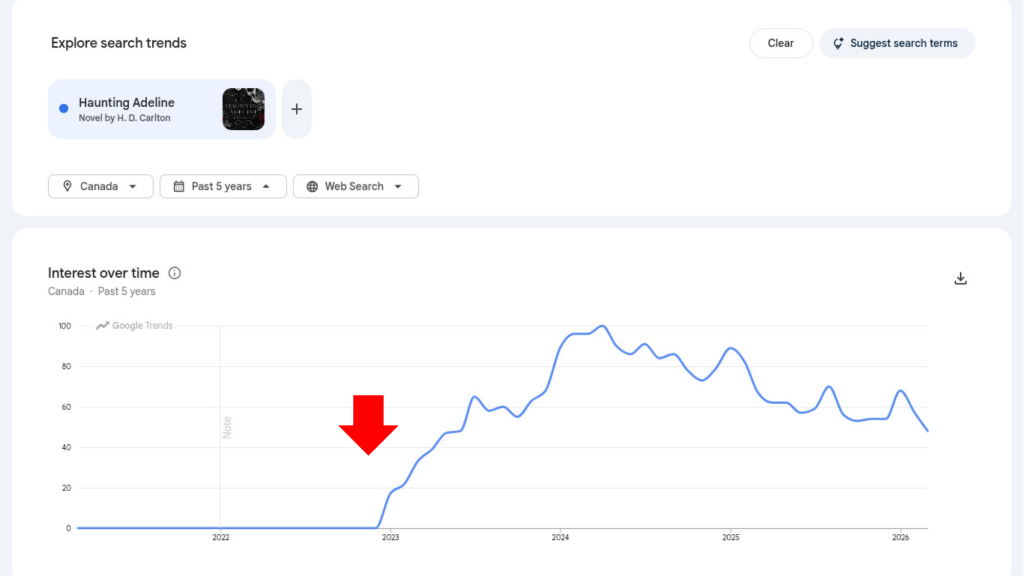
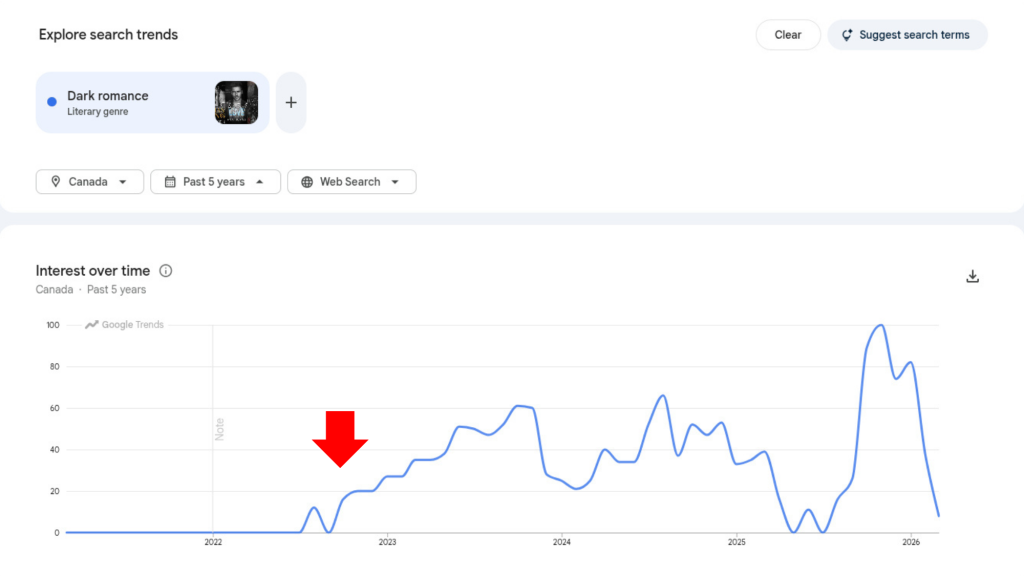
What does this data tell us? There is a good chance that Haunting Adeline “going viral” uplifted the dark romance genre significantly.
Who posted about Haunting Adeline first, therefore starting this wildfire trend? Damned if I know. But here are some of the earliest popular TikToks I found about the book. There is an example of someone who claims to be traumatized by the book, as well as an example of someone talking about it in a more promotional way.
@KierraLewis75 sobbing in her car over the content of Haunting Adeline “being real” is either incredibly heartbreaking…or the best account promotion I’ve ever seen. This woman has tears streaming down her face talking about the content in the book. And because we are a bunch of masochists on the internet, content like this draws people to the book rather than pushing them away.
With @karlilovesbooks, you can see the Haunting Adeline trilogy starting to be promoted as a worthwhile read. No judgement, no melodrama…just a BookTok girlie helping her audience understand the timeline of the books. People online are starting to ask innocent questions about the series, and BookTok delivers.
Modern Dark Romance Today
2010 onward marked a dramatic surge in dark romance’s visibility and commercial success. Several factors contributed to this boom:
- Self-publishing platforms like Kindle Direct Publishing allowed authors to bypass traditional gatekeepers, making it easier to release books with taboo themes.
- Romance subgenre expansion led to readers actively seeking more intense, boundary-pushing tropes.
- The rise of antiheroes in pop culture (from TV dramas to blockbuster films) made morally complex love interests mainstream.
- Digital reading and discreet e-book consumption helped reduce stigma around reading niche or controversial romance.
As a result, dark romance communities flourished online—forums, Goodreads groups, and recommendation threads provided a space for fans to connect and discuss tropes like captor/captive, mafia romance, age gap dynamics, and psychological tension.
Modern dark romance from 2010 to the present has evolved into a fully defined, wildly popular subgenre that embraces morally gray heroes and taboo-driven plots with unapologetic boldness.
Indie publishing and Kindle Unlimited played huge roles in this explosion, giving authors freedom to explore darker themes without traditional gatekeeping…and readers devoured it. This era introduced a wave of signature tropes like mafia romance, captor/captive dynamics, stalker romances, obsessive love interests, and complex power imbalances, all framed with more nuance, consent awareness, and character depth than earlier iterations.
Social media communities, especially BookTok and Bookstagram, amplified the genre’s reach, turning once-niche titles into viral sensations and launching entire author careers overnight.
Today, modern dark romance is a space where readers seek heightened emotion, catharsis, and the thrill of danger, wrapped in the promise of a love story that dares to tread where lighter romances won’t.
With dark romance, trigger warnings are a feature, not a bug. Readers often champion authenticity and emotional vulnerability, making dark romance a perfect fit for their style of passionate engagement.
Why Do Readers Find Dark Romance Appealing?
Readers are drawn to dark romance for its intensity and honesty. The emotional highs and lows are heightened and the forbidden nature of the relationships creates a magnetic pull. Dark romance offers a safe environment to explore uncomfortable fantasies and ethical complexity without real-world consequences.
The genre also provides catharsis: characters confront real trauma scenarios, believable conflicts, and imperfect romance. You’ll get:
- Taboo or forbidden tropes
- Morally gray characters
- “He falls first” or “obsessed love interest” dynamics
- Emotional devastation and catharsis
- Spicy scenes and high-angst storytelling
- Twisted, obsessive, compelling “love”
And of course, the tension (romantic, psychological, and sometimes physical) creates an addictive reading experience that keeps fans turning pages late into the night. These are just a few of the key differences between dark romance and traditional romance. Readers are here to feel a spectrum of emotions, not just “happily ever after.”
We know real life, and real love, is complex, and we like seeing that play out in our fiction.
Dark Romance Books To Introduce You to the Genre
Ready to join us on the dark (romance) side? Here are some popular dark romance books I’ve read and reviewed for you,
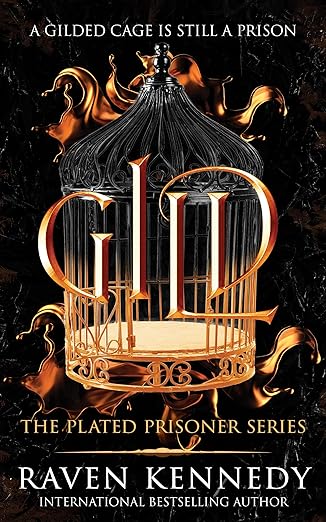
A golden prison is still a prison. Being owned by her King feels safe, but Auren is about to discover there is more to life than just being safe. Gild is a dark retelling of the story of King Midas, for whom everything he touched turns to gold—inlcusing his most prized possession.
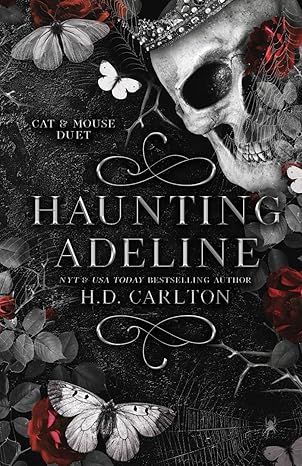
Haunting Adeline by H. D. Carlton (2021)
★★★⯪☆
A Booktok darling. Adeline is pursued by a twisted stalker determined to make her his. She does her best to keep him away…until she starts to realize that’s not what she wants after all. Warning: The book ends on a cliffhanger.
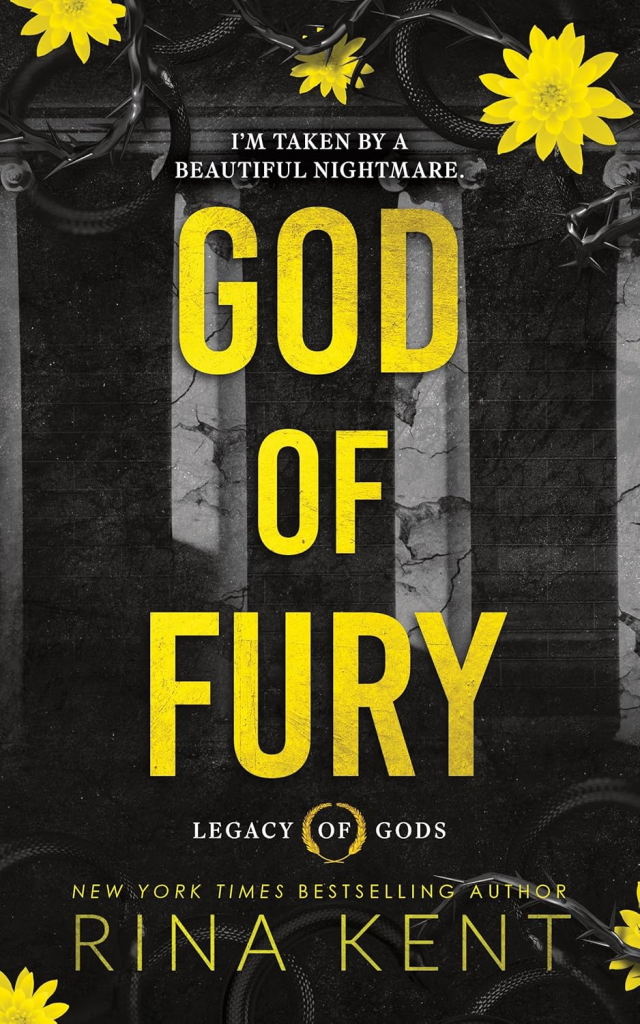
Two college students from warring faction meet under unlikely circumstances, fall in lust, slowly transition into what might be love. Filled with raw explorations of mental illness, a bold narration style, and MM dark romance.
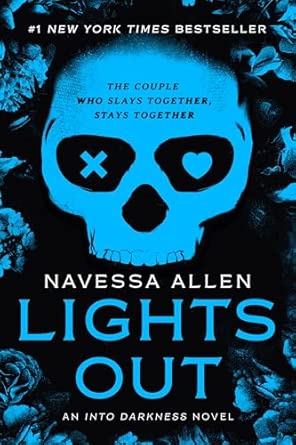
Trauma nurse meets masktok boy and falls head-over-heals. One of the healthiest dark romance relationships I’ve ever read. The main couple doesn’t hurt one another, but I can’t say the same for anyone who gets in their way.
Find Your Dark Romance Niche
Dark Romance isn’t just one thing. It comes in a variety of flavors. Here are some subgenres, topics, or kinks for you to dig into:
- Best Books Like Haunting Adeline
- Best Dark Romance Fantasy Books
- Best Dark Romance Mafia Books
- Best Dark Romance with Trigger Warnings
- Best Queer Dark Romance Books
- Best Dark Romance BL Webtoons
- Best BL Dark Romance Books