The community already knows. They’ve always known. Long before corporate publishing decided to weigh in, dark romance readers were doing the quiet, unglamorous work of protecting each other. Whispering warnings in comment threads, tagging Goodreads reviews with careful asterisks, building spreadsheets shared across dark romance Discord servers with the dedication of archivists preserving sacred texts. This genre didn’t wait for permission. It never does.
But something is shifting. Something more formal. More permanent. Dark romance books, the unapologetic architects of morally grey antiheroes, obsessive love, and brutal emotional terrain, are pioneering the structural use of trigger warnings directly on their pages. Not as apology. Not as disclaimer. As craft. As care. As a quiet revolution tucked between a dedication page and chapter one.
The community built this from the shadows. Now they’re demanding the infrastructure to match.
Trigger Warnings in Books: What’s Happening Now
Here’s the reality, stripped of sentiment: dark romance is no longer a niche whispered about in back corners of the internet. It is a magnetic, sprawling, commercially dominant force and with that dominance comes a readership as diverse as its tropes. The Stalker Romance. The Bully Romance. The Dark Captive Arc. These are not accidents of storytelling. They are deliberate, visceral explorations of power, surrender, and psychological complexity that have earned their place on the shelf. Unapologetically.
And for the uninitiated, the reader arriving fresh from mainstream fiction, curious about the darkness, unsure of their own edges, the absence of a roadmap can turn an act of brave exploration into an ambush.
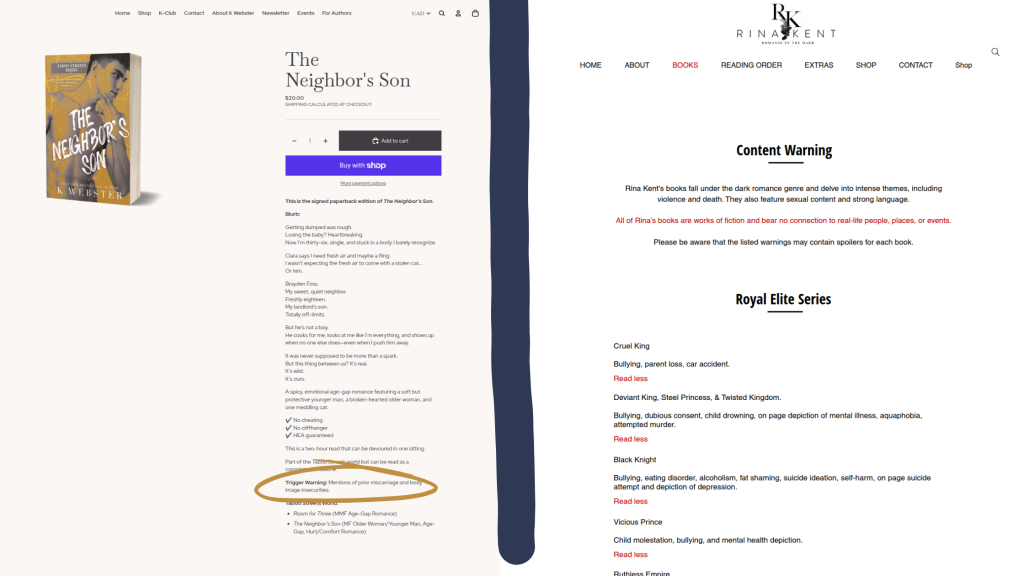
What dark romance authors are doing now is building that roadmap. Trigger warnings appearing in front matter, formatted with specificity and intention: non-consensual elements, graphic violence, childhood trauma, dubious consent, explicit content. Listed not to sanitize, but to orient. The difference is everything.
Authors like H. D. Carlton, Rina Kent, and the broader wave of independently published dark romance writers have normalized this practice at scale. It’s no longer a rare courtesy. It is becoming a standard, a benchmark of authorial responsibility that the genre is setting for itself, ahead of any publisher mandate.
New covers, new tropes, new promises. But this time, the infrastructure is catching up. This time, the warning comes first.
How Trigger Warnings in Dark Romance Make Reading Safe
At its core, this is a conversation about safe exploration and dark romance has always been uniquely positioned to lead it.
The genre exists in a specific psychological space: it offers readers the experience of danger, obsession, and moral complexity from within the absolute safety of fiction. That is not a bug. That is the entire architecture. Readers processing trauma, readers curious about their own psychology, readers who simply want to feel the full, unfiltered emotional spectrum. They come to dark romance because it doesn’t flinch. The trigger warning doesn’t dismantle that. Convincingly, it deepens it.
Think of it this way: the warning is the lock on the door that you hold the key to. It doesn’t keep you out. It hands you control. For a survivor of assault encountering a non-con storyline without warning, the reading experience can shift from liberation to retraumatization in a single chapter. That is not dark romance doing its job. That is dark romance failing its reader.
The trigger warning restores the contract. It says: I see you. I know what lives in these pages. Come in with your eyes open. And for the reader who needs that content, who finds catharsis in the darkness, who processes grief and fear and desire through these stories, the warning is not a deterrent. It is an invitation.
This is the nuance that mainstream publishing has consistently fumbled. The reflex to soften dark content for broader audiences, the PG-13 adaptation, the sanitized reprint, dodging even a whiff of controversy, the studio note that jilts the very readers who built the fandom. It misunderstands the assignment entirely. Dark romance doesn’t need to be made safe. It needs to be made navigable. Those are not the same thing.
The trigger warning also does something quieter, something more profound: it validates the weight of what’s inside. It says this book takes itself seriously. It acknowledges that kink, trauma, obsession, and power dynamics carry real psychological gravity. These are not cheap shock tactics but deliberate emotional territories deserving of respect. For authors, it is an act of authorial confidence. For readers, it is proof of being seen.
Buckle in for the long haul, because this shift matters beyond the genre. Dark romance is, once again, turning the broader conversation about reader care on its head.
Dark Romance Leads the Way, Traditional Publishing Must Follow
The deal is simple. The intention is clear. But the implications are enormous.
Trigger warnings in dark romance are not a trend. They are not a corporate concession or a marketing strategy. They are the genre doing what it has always done best. Building community infrastructure from the inside out, refusing to wait for the industry to catch up, and centering the reader’s experience as a form of radical respect.
This shines brightly. Not because it softens the darkness. It doesn’t. But because it makes the darkness accessible. Because it ensures that the reader who needs this genre, who relies on it for exploration, for catharsis, for the profound psychological release of fictional danger, can enter on their own terms.
Sign Off…
Dark romance built this space with bare hands. The trigger warning is simply a proper door. And for the first time, everyone who needs it gets to choose whether to walk through.
The genre didn’t ask permission to go dark. It’s not asking permission to be mindful, either.
Dark Romance Book Lists You Might Like:
- Best Books Like Haunting Adeline
- Best Dark Romance Fantasy Books
- Best Dark Romance Mafia Books
- Best Queer Dark Romance Books
- Best Dark Romance BL Webtoons
- Best BL Dark Romance Books